
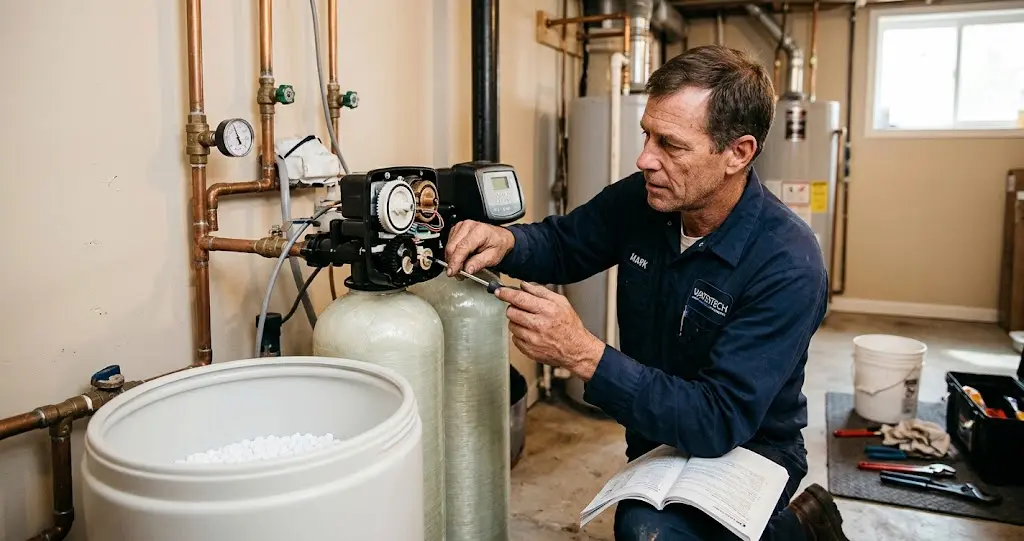
Water Softener Repair can help restore your water softener’s performance when you notice hard water spots, mineral buildup, or reduced water quality. Common issues include salt bridges, clogged resin beads, blocked valves, and incorrect regeneration settings. Understanding Water Softener Repair makes it easier to identify potential problems and determine whether you can fix them yourself or need professional assistance.
This step-by-step guide explains how to troubleshoot common water softener problems, check salt levels, clean the brine tank, inspect settings, and recognize signs of mechanical failure. Regular maintenance can also help prevent recurring issues and extend your system’s lifespan. With the right approach, Water Softener Repair can improve efficiency, reduce unnecessary expenses, and help keep your home’s water soft and comfortable for everyday use.
What is a Water Softener?
A water softener is a home appliance that removes calcium and magnesium from your water supply. These minerals cause water hardness. In fact, the USGS defines hardness as the amount of dissolved calcium and magnesium in water,Most homes use a salt-based unit. It has two main parts: a mineral tank that holds resin beads, and a brine tank that holds salt. Together, they swap hard minerals for sodium or potassium ions. As a result, your pipes, heaters, and appliances face less scale.
Homeowners who rely on a private supply often need a softener the most. Well water usually carries more minerals than city water. If that sounds like your home, our well pump repair guide explains how pump and pressure issues can look like softener faults.
How Does a Water Softener Work?
A softener uses a process called ion exchange. The steps are simple:
- Hard water enters the mineral tank.
- Resin beads grab calcium and magnesium ions.
- The beads release sodium ions in return.
- Soft water flows out to your taps.
However, the beads fill up over time. Then the regeneration cycle starts. The control valve pulls salty brine from the brine tank, and the brine washes the trapped minerals down the drain. Finally, a rinse step clears out the extra salt, and the unit returns to service.
Most modern units regenerate on demand. A flow meter counts the gallons used, and the head starts a cycle only when the beads need a recharge. Older units use a fixed timer instead. Because of that, timer models waste more salt and water.
Since each part depends on the next, one small fault can stop the whole chain. Therefore, a quick look at each part usually points to the cause.
Water Softener Maintenance
Good habits prevent most repairs. For example, a monthly check takes about five minutes and catches trouble early. Our own water heater repair guide makes a similar point, since scale from hard water shortens the life of any heating element.
Use this routine to keep your system healthy:
- Check the salt level once a month and refill when it drops below half.
- Break up crusts on top of the salt with a broom handle.
- Clean the brine tank once a year and remove any sludge.
- Test your water hardness every few months with a simple test kit.
- Add a resin cleaner if your water carries iron.
- Look for leaks around the bypass valve and drain line.
- Review the settings after any move, repair, or change in water source.
Moreover, choose the right salt. Pellet salt and evaporated salt work best, while rock salt leaves more residue. Cheap salt often causes mushing, so quality matters here.
The table below shows how often each task should happen.
| Task | How Often | Time Needed |
| Check salt level | Monthly | 2 minutes |
| Break up salt crust | Monthly | 3 minutes |
| Test water hardness | Every 3 months | 5 minutes |
| Clean resin bed | Every 6 months | 20 minutes |
| Deep clean brine tank | Yearly | 45 minutes |
| Professional inspection | Every 2 years | 1 hour |
More Read: Water Heater Repair Guide: 10 Common Problems, Solutions
Water Softener Repair Issues
Most faults fall into a few groups. Some are mechanical, some come from salt, and some come from settings. The table below shows how they compare.
| Issue | Typical Cause | DIY Difficulty |
| Hard water returns | Spent resin or low salt | Easy to moderate |
| Salt bridge | Humidity or wrong salt | Easy |
| Salt mush | Salt sitting in sludge | Moderate |
| Low pressure | Clogged resin or valve | Moderate |
| Stuck regeneration | Faulty timer or valve | Hard |
| Too much water in tank | Blocked drain or injector | Moderate |
Notably, the first three rows need no special tools. On the other hand, valve and motor faults often need a trained technician. Furthermore, repair costs vary by part. A new injector or brine valve costs little, while a full control head can cost several hundred dollars.
Water Softener Troubleshooting Tips
Before you open anything, follow a basic order. First, confirm the unit has power. Next, check the salt. Then, look at the settings and the water flow. This order solves most cases within minutes.
Keep these tips in mind:
- Put the unit in bypass mode before any repair, so water keeps flowing.
- Unplug the unit before you touch the control head.
- Take photos of settings before you change them.
- Write down the error code if the display shows one.
- Read the manual for your brand, since models differ.
- Use a flashlight to inspect the drain line and the brine well.
Also, work slowly. A rushed repair often turns a minor issue into a costly one. In addition, keep a small log of every change you make. That record helps a technician if you need to call for service later.
Water Softening Articles
Looking for more guidance on soft water systems? The sections below cover the most common faults in detail.
Water softener troubleshooting: Common problems and solutions
Most softener faults trace back to salt, settings, or flow. Fortunately, you can test each one without special skills. This part of the guide shows you what to watch for and how to fix it.
Signs your water softener might need attention
Your home usually gives clear hints before the system fails completely. For instance, you may notice:
- Spots and film on dishes and shower doors
- Dry, itchy skin and dull hair
- Soap that refuses to lather
- Scale on faucets and showerheads
- Laundry that feels stiff
- A sudden rise in your water bill
- A salty taste in drinking water
If you spot two or more of these, test your water. A reading above one grain per gallon after softening means something is wrong. Meanwhile, do not wait for a total failure. Scale damages heaters and pipes long before you see it.
Water softener troubleshooting signs
Each sign points toward a likely cause. Use this table to narrow the search.
| What You See | Likely Cause | First Check |
| Scale returns | Low salt or spent resin | Salt level |
| Salty water | Too much brine draw | Settings and injector |
| Brown or rusty water | Iron in the supply | Resin cleaner |
| Weak flow | Clogged resin bed | Bypass valve |
| No regeneration | Power or timer fault | Display and plug |
Consequently, a short test often saves a service call. Many of these faults involve salt level, regeneration timing, or water flow, so those three areas deserve a look first.
Wondering how to handle hard water?
Start with a home test kit and a clear look at your grains per gallon reading. Then match the fix to the result.
Troubleshooting 6 common water softener problems
The six faults below cause most service calls. Check them in order, because the early ones are the easiest to fix. Before you start, make sure the unit is plugged in and the brine tank holds enough salt.
1. Salt bridging
A salt bridge forms when a hard crust builds across the salt, leaving an empty gap below. As a result, the salt cannot dissolve, and the unit makes no brine. Your water then turns hard even though the tank looks full.
Warning signs include a tank that looks full but never drops, and hard water despite regular refills.
How to fix it:
- Press a broom handle gently into the salt to test for a hollow space.
- Break the crust into small pieces.
- Remove any large chunks by hand.
- Switch to pellet salt and avoid overfilling.
Humidity is a common cause. Therefore, store the unit in a dry spot and keep the lid closed. Likewise, fill the tank only halfway in warm, damp climates.
2. Salt mushing
Salt mushing happens when salt breaks down into a thick sludge at the bottom of the tank. This sludge clogs the brine line and blocks flow. Meanwhile, the softener keeps running but delivers hard water.
To fix it:
- Bypass the unit and shut off the water.
- Scoop out the salt and sludge.
- Wash the tank with warm water and mild soap.
- Rinse well, then refill with fresh salt.
- Run a manual regeneration to restore the system.
Besides cleaning, avoid cheap salt blends. They contain more insoluble matter and form sludge faster. In many homes, this single change stops the problem for good.
3. Low water pressure
Low pressure after a softener often points to a clogged resin bed or a blocked injector. Iron and sediment cause most of these clogs. In addition, older resin beads can break apart and block the valve screen.
Try these steps:
- Test the pressure with the bypass open and closed.
- If pressure improves in bypass, the softener is the cause.
- Clean the injector and screen.
- Add resin cleaner if you have iron.
- Replace the resin if the beads are old and crumbled.
Moreover, low pressure may come from the plumbing itself. Our pipe repair and replacement guide covers corroded lines that restrict flow. Likewise, a partly closed shutoff valve near the unit can cut flow, so check that first.
More Read: Pipe Repair and Replacement: Step-by-Step Homeowner Guide
4. Regeneration issues
A unit that never regenerates, or one that never stops, usually has a timer, sensor, or valve fault. Sometimes the fix is as simple as a wrong clock setting after a power cut.
Check these items:
- Confirm the unit has power and a lit display.
- Reset the time of day and the regeneration schedule.
- Make sure the hardness setting matches your latest test.
- Start a manual regeneration and listen for water movement.
- Inspect the drain line for kinks or clogs.
If the cycle still fails, the flow meter or motor may be bad. In that case, call a pro, because these parts need careful handling. Also, a unit stuck in regeneration wastes large amounts of water, so act quickly.
5. Standing water in the brine tank
Some water in the tank is normal. Too much is not. A tank full of water often means the brine valve or float is stuck, or the drain line is blocked. Also, a bad injector can stop the tank from draining during the cycle.
To fix it:
- Remove the salt lid and check the water level.
- Clean the float assembly.
- Clear the drain line and the air check.
- Replace a worn brine valve.
- Run a manual cycle to confirm the tank empties.
If you see an overflow, shut off the supply right away. Otherwise, water can damage the floor around the unit. In that case, our leak detection and repair guide shows how to find hidden moisture before it spreads.
6. Error codes and alerts
Modern units show error codes on the display. Each brand uses its own list, so the manual matters most here. Common alerts point to low salt, a motor fault, a sensor failure, or a power loss.
What to do:
- Write down the exact code.
- Unplug the unit for one minute, then restart it.
- Look up the code in the manual.
- Clear simple alerts, such as low salt, by refilling.
- Call a technician if the code returns after a reset.
Importantly, never ignore repeated codes. They signal a fault that will not fix itself.
More Read: Leak Detection & Repair: Find Hidden Leaks Before They Cause Damage
When to consider an upgrade
Repair is not always the best choice. For example, a unit over fifteen years old often costs more to fix than it saves. Likewise, repeated valve failures signal a worn system.
Consider a replacement when:
- The resin needs changing and the valve is also failing.
- Repair bills approach half the price of a new unit.
- Your household grew and demand rose.
- Your unit wastes large amounts of salt and water.
Newer models use demand-initiated regeneration. This feature regenerates only when needed, which cuts salt and water use. The table below compares repair and replacement.
| Factor | Repair | Replace |
| Upfront cost | Low | Higher |
| Best for | Units under 10 years | Units over 15 years |
| Efficiency gain | None | Noticeable |
| Warranty | Parts only | Full coverage |
| Downtime | Short | Moderate |
Still, weigh the numbers for your own home before you decide.
Benefits of upgrading to a Culligan water softener
Brands such as Culligan promote high-efficiency valves, smart controls, and local service support. , a local expert can evaluate your system and recommend repair or replacement. Still, compare several brands and warranties before you buy.
Possible benefits include:
- Lower salt and water use
- Better flow rate for larger homes
- Smart alerts for low salt
- Longer warranties on valves and tanks
- Easy access to certified service
Explore water softening solutions.
Review your water test, household size, and budget. Then match them to a unit with the right grain capacity.
Water softener troubleshooting FAQs
How can I tell if my water softener isn’t working properly?
Look for spots, scale, dry skin, and soap that will not lather.
Why is my water softener full of water?
A stuck float, blocked drain line, or bad injector usually causes it.
How do I reset my water softener?
Unplug the unit for a minute, plug it back in, then reset the clock and settings.
Should you disconnect your water softener?
Only bypass it for repairs, and disconnect fully if you are replacing it.
Why did my water pressure drop after installing a softener?
A clogged resin bed, a blocked valve, or a small pipe size often causes it.
What’s the average lifespan of a water softener?
Most units last between ten and fifteen years with regular care.
Can Culligan service other water softener brands?
Yes, Culligan states that it can evaluate non-Culligan models too.
Keep your water softener performing effectively
A softener rewards steady care. Check the salt, test the water, and watch for early signs of trouble. In addition, clean the brine tank each year and use quality salt. When a fault does appear, work through the six common problems in order, and bypass the unit before any hands-on repair.
Finally, know your limits. Simple jobs like breaking a salt bridge suit most homeowners. Valve, motor, and electronics faults, however, call for a trained technician. Plumbing problems can also overlap, so a leaking line or a slow drain may need separate attention. For that reason, see our faucet and fixture repair guide and our drain and sewer line repair guide when symptoms look similar.
More Read: Plumbing Repair: What Every Homeowner Should Know Before Something Goes Wrong